
 By First Compliance
The Cost of Non-Compliance: What UAE Businesses Risk Without Proper CDD Software
The Cost of Non-Compliance: What UAE Businesses Risk Without Proper CDD Software

Customer Due Diligence (CDD) is no longer just a compliance formality for businesses in the UAE. It is an important part of protecting a company from money laundering, fraud, sanctions risks, and other financial crimes. Businesses operating in regulated sectors need to know who their customers are, understand their activities, identify beneficial owners, assess risk, and keep customer information up to date.
UAE regulations require relevant businesses to apply risk-based CDD measures and maintain appropriate records and controls. The rule also requires going monitoring and stronger measures for higher-risk customers. This is where customer due diligence software in Dubai can make a major difference. Instead of depending on spreadsheets, emails, paper documents, and disconnected checks, businesses can use technology to create a more organised and consistent compliance process.
The real cost of poor CDD is not limited to a possible penalty. It can affect operations, reputation, customer relationships, and long-term business growth.
Why CDD Has Become a Business Priority in the UAE?
CDD helps businesses understand the people and organisations they deal with before and during a business relationship. Depending on the customer and risk level, this can involve identity verification, beneficial ownership checks, understanding the purpose of the relationship, sanctions screening, and ongoing monitoring.
A strong CDD process can help businesses:
- Verify customer identities
- Identify beneficial owners
- Understand customer activities and business relationships
- Assess customer risk
- Identify higher-risk customers
- Support sanctions and PEP screening
- Keep customer information updated
- Maintain proper compliance records
- Support ongoing monitoring
The Cost of Manual Due Diligence
Many businesses start with basic compliance processes. Customer information may be stored in spreadsheets, documents may be shared through email, and screening may be performed manually.
Manual processes can lead to:
- More administrative work: Employees spend valuable time collecting documents, entering information, checking records, and following up on missing data.
- Inconsistent processes: Different employees may follow different procedures, creating gaps in the customer review process.
- Delayed onboarding: Customers may have to wait while compliance teams complete several manual checks.
- Poor visibility: Management may struggle to understand the overall status of customer reviews and outstanding compliance tasks.
- Higher human-error risk: A missed document, incorrect entry, or overlooked alert can create unnecessary compliance exposure.
What Can Businesses Risk Through Non-Compliance?
- Regulatory and Financial Exposure
- Regulatory penalties or enforcement action
- Additional compliance expenses
- Costs associated with remediation
- External legal or compliance consultancy fees
- Increased internal audit requirements
- Reputation Damage
- Does the company know who its customers really are?
- Are beneficial owners being properly identified?
- Are sanctions and high-risk customers being screened?
- Are suspicious activities being monitored?
- Can the company produce reliable compliance records?
How Can Weak CDD Disrupt Everyday Operations?
Non-compliance is not only a legal or regulatory problem. It can also create operational problems. Imagine a compliance team managing thousands of customer records using spreadsheets. Some customer documents may have expired, some reviews may be overdue, and some high-risk cases may require enhanced due diligence.
Without a central system, employees may spend hours searching for information and checking whether actions have been completed.
This can result in a cycle of:
More customers → more manual work → more delays→ greater chance of mistakes → more compliance pressure.
Proper technology helps break this cycle by organising workflows and making compliance tasks easier to track.
How Customer Due Diligence Software in Dubai Helps?
Modern compliance software can bring several CDD activities together in one platform.
First Compliance provides an integrated platform covering customer onboarding, KYC, eKYC, due diligence, sanctions screening, PEP screening, adverse media screening, risk management, transaction monitoring, case management, and regulatory reporting.
Important capabilities can include:
- Digital customer onboarding: Capture and verify customer information through structured digital workflows.
- Identity verification: Support identity checks using digital verification processes.
- Risk assessment: Apply configurable risk models based on customer and business factors.
- Screening: Check customers and relevant parties against sanctions, PEP and other compliance data.
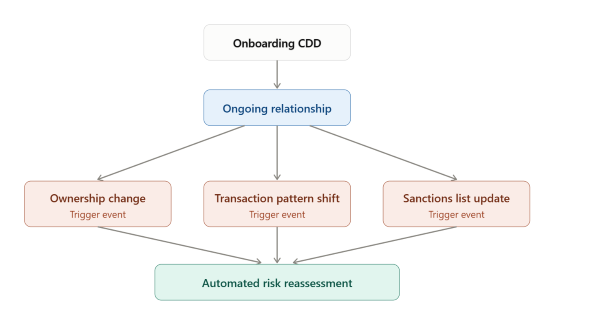
- Ongoing monitoring: Help identify changes and activities that may require further review.
- Document management: Keep important compliance information organised and accessible.
- Case management: Track alerts, investigations, decisions, and follow-up actions.
- Audit trails: Maintain records of compliance activities and decisions.
- Reporting: Generate structured reports for management and compliance teams.
The Business Benefits Go Beyond Compliance
One of the biggest misconceptions is that compliance software only helps companies satisfy regulators. In reality, an effective CDD platform can also improve business efficiency.
Faster Customer Onboarding: Digital workflows can reduce unnecessary manual steps and help compliance teams review customer information more efficiently.
Better Compliance Visibility: Dashboards and centralised records can help management understand open cases, risk levels, pending reviews, and other compliance activities.
Fewer Manual Errors: Automation can reduce repetitive data-entry tasks and create more consistent processes.
Easier Investigations: When customer information, screening results, documents, alerts, and case records are connected, compliance teams can investigate issues more efficiently.
Greater Scalability: A manual process that works for 100 customers may become difficult to manage for 10,000 customers. Technology allows compliance processes to scale with business growth.
What Should UAE Businesses Look for in CDD Software?
Choosing software should not be based only on the number of features. Businesses should consider whether the platform fits their actual compliance framework.
Before selecting a solution, consider:
- Regulatory alignment: Can the system support the compliance requirements relevant to your sector?
- Risk-based workflows: Can different risk levels trigger suitable review processes?
- Screening capabilities: Does it support sanctions, PEP and adverse media screening where required?
- Automation: Can repetitive compliance activities be streamlined?
- Auditability: Can the organisation demonstrate what checks were performed and when?
- Integration: Can the platform connect with existing business systems?
- Scalability: Can it support increasing customer volumes?
- Security: Does it provide access controls and data protection?
- Reporting: Can compliance teams generate useful management and regulatory reports?
- Configurability: Can workflows change as business and regulatory requirements evolve?
How to Reduce CDD Risk?
Businesses do not need to view compliance as a burden. A structured approach can make it part of normal business operations.
A practical CDD framework can follow these stages:
Step 1: Identify the customer – Collect the information and documents required for the customer type.
Step 2: Verify identity and ownership – Verify the customer and identify relevant beneficial owners.
Step 3: Understand the relationship – Understand the nature and purpose of the business relationship.
Step 4: Assess risk – Evaluate customer, geographic, product, transaction, and other relevant risk factors.
Step 5: Apply appropriate controls – Use standard or enhanced measures according to the risk identified.
Step 6: Monitor and review – Keep customer information relevant and up to date and conduct ongoing monitoring where required. UAE rules specifically require ongoing CDD and monitoring for applicable business relationships.
Step 7: Maintain records – Keep appropriate evidence of checks, decisions, reviews, and actions. Technology can support each stage while giving compliance teams a central view of the customer lifecycle.
Why First Compliance Can Support a Stronger CDD Framework?

At First Compliance, we understand that compliance needs to work in the real world, not just on paper.
We provide an integrated compliance platform that brings customer onboarding, due diligence, KYC, sanctions screening, risk management, transaction monitoring, investigations, and reporting into one environment.
Our platform supports configurable workflows, risk models, digital onboarding, eKYC, screening, document management, case management, and reporting. We also support cloud and on-premise deployment options, allowing organisations to select an approach that suits their operational requirements.
For UAE businesses, the goal is simple: make compliance more organised, measurable, and manageable while reducing the risks associated with fragmented processes.
Final Thoughts
Customer due diligence is a fundamental part of effective financial crime risk management. UAE regulations require relevant businesses to identify customers and beneficial owners, understand business relationships, assess risks, conduct appropriate CDD, and maintain ongoing monitoring and records.
The right customer due diligence software in Dubai can help businesses organise customer information, automate key checks, manage risk, monitor relationships, maintain records, and improve operational efficiency.
Frequently Asked Questions
What is Customer Due Diligence (CDD)?
Customer Due Diligence is the process of identifying and verifying customers, understanding their business relationship and assessing relevant financial crime risks.
Is CDD mandatory for UAE businesses?
CDD requirements apply to relevant Financial Institutions, Designated Non-Financial Businesses and Professions (DNFBPs), and other entities covered by UAE AML regulations.
What does customer due diligence software do?
CDD software helps businesses organise and automate activities such as customer onboarding, identity verification, risk assessment, screening, document management, ongoing reviews, case management, and reporting.
Can CDD software replace a compliance team?
No. Software supports compliance professionals by automating repetitive tasks, organizing information, and improving visibility. Businesses still need appropriate policies, controls, oversight, trained employees, and management responsibility.
How does CDD software help with high-risk customers?
A suitable platform can use risk-based workflows to identify customers requiring additional review and support enhanced due diligence processes.
Why choose First Compliance for CDD and AML management?
First Compliance provides an integrated platform covering customer onboarding, KYC, due diligence, sanctions and PEP screening, risk management, transaction monitoring, case management, and regulatory reporting. Its configurable workflows and scalable architecture are designed to support regulated organisations as their compliance needs evolve.